
Want to improve the next 20 seconds of your life? Try this.
Make sure you’re in a comfortable position, preferably seated and free of distractions, and try to relax your shoulders and body.
Start by inhaling for 6 seconds…
Then hold for 2 seconds…
Now exhale slowly for 8 seconds, pursing your lips slightly as you do.
Notice how you feel. You should feel slightly calmer, more relaxed, and your heart-rate may have even dropped a few beats per minute. Repeat this a few more times and you’ll start to see the untapped power you carry inside you; a power we all carry yet most of us hardly ever use.
What’s happening to you on a physiological level is you’re triggering what’s called the vagus nerve. It’s an integral part of your autonomic nervous system, specifically the parasympathetic nervous system, which calms your body after you’ve been in a stressful situation.
The vagus nerve system acts to counterbalance the fight or flight system and can trigger a relaxation response in our body. It is one of the cranial nerves that connect the brain to the body. The vagus nerve is a major part of how our bodies and brains function; without it, our bodies wouldn’t be able to do basic tasks, and by stimulating it we can receive powerful health benefits.
One of the main ways that you can stimulate the healthy function of the vagus nerve is through deep, slow breathing. You can learn to use breathing exercises to shift your focus away from stress or pain. The human mind processes one thing at a time. If you focus on the rhythm of your breathing, you’re not focused on the stressor.
The moment we anticipate stress in any form, most of us tend to stop breathing and hold our breath. Breath holding activates the fight/flight/freeze response; it tends to increase the sensation of pain, stiffness, anxiety, or fear. To practice deep breathing inhale through your nose and exhale through your mouth remember to:
- Breathe more slowly (aim for six breaths per minute).
- Breathe more deeply, from the belly. Think about expanding your abdomen and widening your rib cage as you inhale.
- Exhale longer than you inhale. It’s the exhale that triggers the relaxation response.
This breathing exercise is one I try to practice multiple times a day – that is, when I actually remember to do it – but I’ve found a solution to that problem, which I’ll get to below.
My regular daily pattern is one of task-switching, lack of deep focus, and constant catching my breathe as I’m bombarded with one distraction after another. Expended effort on nothing important, consumption of garbage media, over-stimulated dopamine responses – this may sound familiar.
Consume, distract, feel anxious. Repeat.
This is the the ritual of an overwhelming number of modern adults and children. Doctors will often prescribe medication for anxiety, but by leaping to medication before trying to reimplement the natural patterns and functions of your body – ones that have evolved and been maintained over hundreds of thousands of years (and longer) and are what your body is designed to do – can have very negative and counterproductive results.
Mindful and deliberate breathing is one of those mechanisms that have evolved and used by many ancient philosophers, monks, warriors, and modern athletes.
OK, so we’ve established that being mindful of your breathing is important and has serious implications about your mental and physical health; but how do we actually make a change in our habits right now? Ones that will lead to more mindful breathing and less anxiety/stress?
Here are 3 super simple actions you can take to build this habit with very little effort:
1. Schedule it into your day
Set alarms in your calendar to stop and do focused breathing, even if it’s just for one minute. Start as small as you need to to make sure that it’s easy enough to achieve. The idea is to set a small goal and achieve it, then work your way up.
2. Create obvious breathing triggers
You can create triggers that remind you to breathe and become aware of the moment.
For example, every time your in traffic, it can be a trigger to do a breathing exercise and slow your exhale until you achieve a state of calm. The worse the traffic, the more breaths you take.
Social events, going into work, whatever it is, you can create these automatic triggers for stress that become reminders to stop and breathe, focus on your exhale, and totally shift your mindset and your relationship to the current moment.
3. Use an ever-present tool
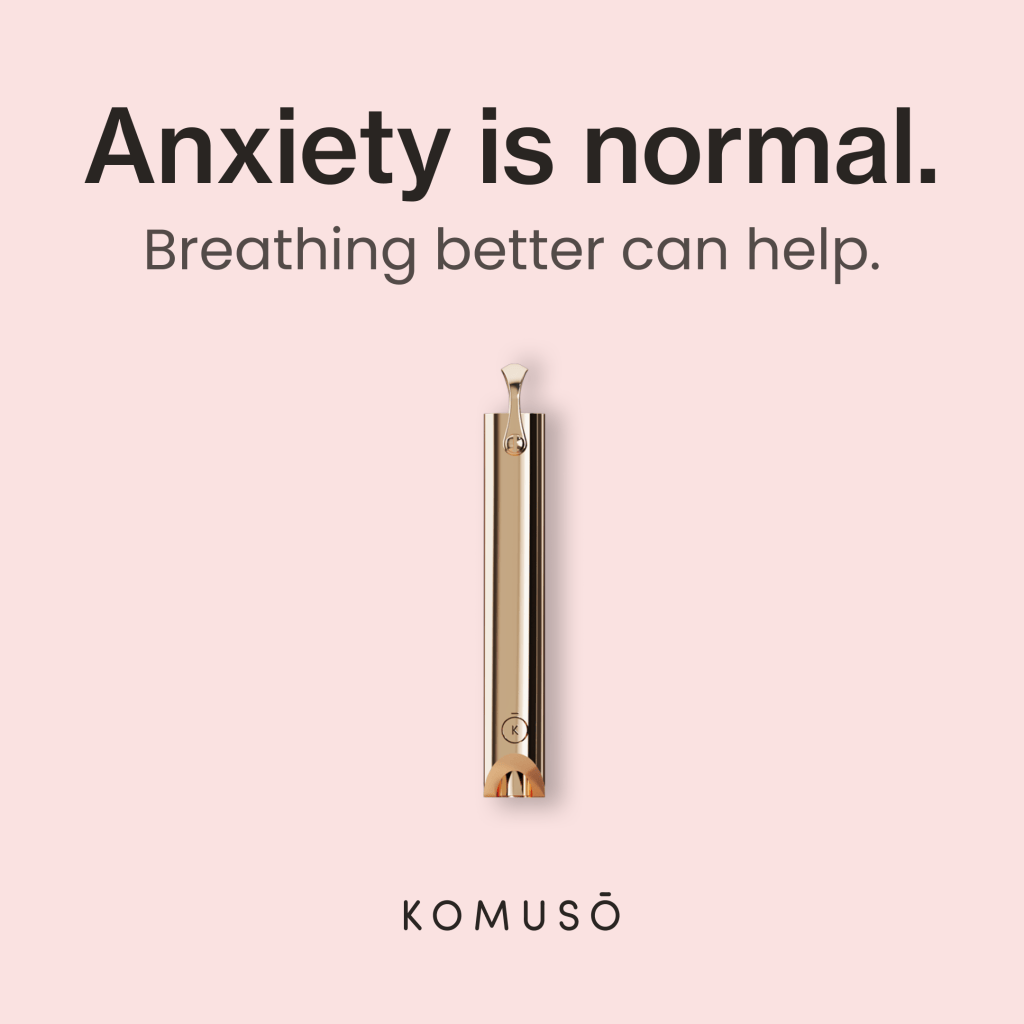
There’s actually a necklace specifically designed for this purpose, called the Shift necklace, by Komuso Design. Since it’s wearable, it acts as an ever-present reminder to breathe properly and be mindful of how you’re feeling in the moment.
The other really interesting thing about the Shift necklace is that it is actually a wearable tool that you breathe through to slow your exhale and relieve anxiety and stress. The patented device has a circumference specifically designed by a therapist to slow your exhale the perfect amount so that you can achieve a perfect breath.

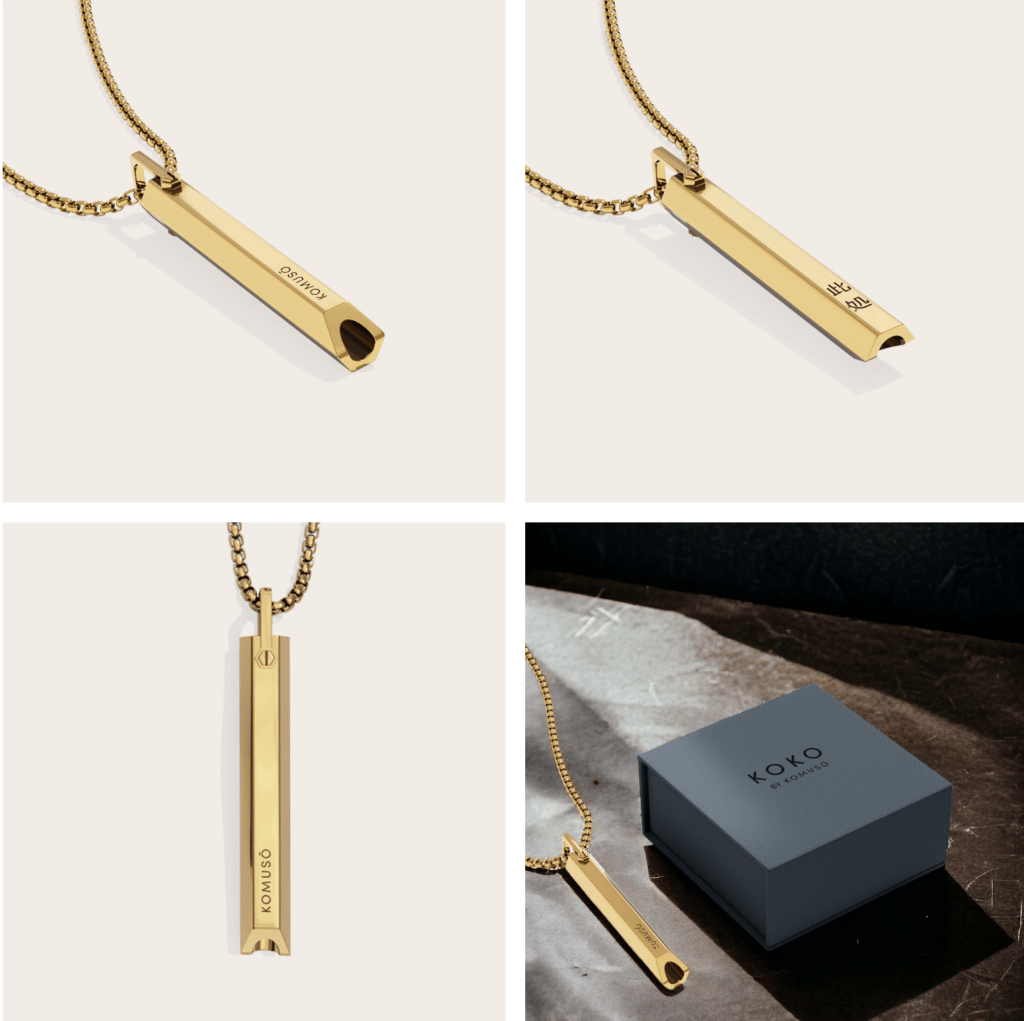
The Shift necklace was inspired by ancient Japanese monks, called the Komusō monks, which is how Komuso got its name. On a trip to Japan, the founders Todd and Vanessa discovered the flutes that the Komusō used as musical instruments and as breathing tools for meditation.
They spent over a year designing and refining this device to be a beautiful piece of jewelry that is also a profound tool, a reminder to breathe, and a symbol of a kind of lifestyle centered around mindfulness and living in the present.

The authentic reviews and feedback from thousands of customers was actually staggering. I looked through comments on ads they had running, and there were testimonials of many people who were skeptical of this ‘metal straw’ but who gave it a try and found that it had a profound impact.
Many people found that it became a replacement of bad habits – like smoking and vaping, or picking at their scalp and skin. This wasn’t the original intention behind the Shift, but it shows the profound power of how conscious breathing can affect your mental and physical health.
It demonstrates that the natural power of conscious breathing extends far beyond what we realize.
Do you need a tool or device to assist you in developing a conscious breathing habit? Of course not. But in my experience, and the experience of thousands of others, the Shift necklace became a crucial tool in creating a conscious breathing habit and serving as a reminder to simply engage in the moment and be present.
Personally, I like the weight of the necklace and the feeling of it sitting against my chest. Often times just putting my hand against it in a moment of stress or anxiety serves as a reminder to breathe and notice my thoughts. This is perfect for moments when I don’t want to use my Shift necklace in public, but it demonstrates how it still helps me beyond the fact that it is used as an actual tool.
Komuso is actually offering up to 25% off your Shift, with a 30-day money back guarantee. You can pick one up here. They have different colors, materials, styles, and price ranges for every preference and budget.
Master the power of your breath, and you’ll find the simplest and most natural way to improve your life. The impacts will be more profound than you think.
Let’s seize the day.
-MC